Welcome to the Language Revival page. You can find posts about the Kurdish language and ways to enhance the revival of this language so that it can continue to develop and thrive.
We recognise that the Kurdish language has always truly formed an independent branch of the Indo-European language family.
Post 3
Using Kurdish names when writing and speaking Kurdish.
From Kurdish Writing.
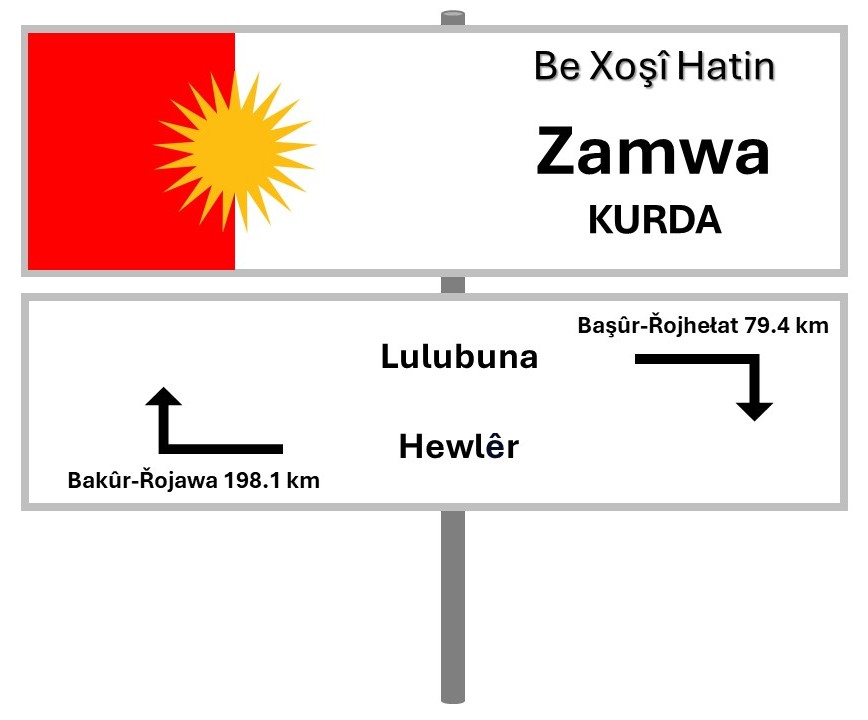
The ancient name of the city currently known as “Slemani” is Zamwa, which was within the Kingdom of Lulubi since around 3100 BCE.
The region of Lulubi itself was also called Zamwa. The name Zamwa is still used, although less frequently, as the name for the city today.
It is common for cities to begin as smaller settlements, eventually becoming larger and officially being called a city. For example, the city Yerevan was a smaller settlement called Erebuni, part of the Kingdom of Urartu.
Therefore, Zamwa existed from around 3100 BCE, not from the 1700s CE. Rather, one of the major expansions of Zamwa, becoming a larger city, occurred in the 1700s CE.
The name “Slemani” is not of Kurdish origin, making it inappropriate to use as a name in the Kurdish language. The ancient Kurdish name, Zamwa, reflects its ancient history. Evidence also shows that the name Lulubi is of Hurrian Kurdish origin.
The Kingdom of Lulubi was disestablished around the 7th Century BCE, around the time when the Medes Empire was established.
Evidence suggests that the ancient name for the city of “Halabja” is Lulubuna, which was also within the Kingdom of Lulubi. Like “Slemani”, the name “Halabja” is not of Kurdish origin, making it inappropriate to use as a name in the Kurdish language. The name “Lulubuna” reflects its ancient history, also being a name of Hurrian Kurdish origin.
Although the transliteration of Zamwa to the Latin Script may also appear as “Zamua”, due to the presence of the letter ‘W‘ in the Kurdish Latin Alphabet the name would be spelt as Zamwa.
The name of the city Hewlêr is a Kurdish name. Older forms of the city name Hewlêr are found as Urbilum/ Urbillum/ Urbelum in Sumerian, and Arbilum in Hurrian.
Why should Kurdish names be used when speaking Kurdish?
Using Kurdish vocabulary, Kurdish nouns, including names of relevant cities, towns and settlements, is a way to demonstrate the existence of this language, being a crucial step in preserving the unique identity of this language.
Post 2
Etymology of some Kurdish words.
Water
Car
Bicycle
Wheel
Warm/ Hot
Star
Hand
Three
Five
New
Heart
Post 1
Etymology and meaning of the words Kurd and Kurmancî, and names for the Kurdish settlement area.
The word Kurd

In ancient Sumerian, the word Kur represents ‘mountain’. A suffix was added to form the word Kurti, referring to people who lived in the mountains, specifically the Zagros and Taurus mountains. Over time, the t in this word was often interchangeable with d, forming the word Kurd.
Variations of the word Kurd also exist, including the root nouns Gut and Gord.
Other names have been given to the indigenous people living within the Zagros-Taurus mountains, Mesopotamia, Anatolia and the Caucasus. Some of which (names in English) include Hurrian, Mitanni, Urartian, Nairi, Kassite, Mede, Elamite, Mannean, Lulubi, Gutian.
Why is this important?
The word Kurd appears often in the Kurdish language, including in the name of the language itself. It makes sense for more research to be carried out on the etymology, usage and transformation of this word along with other words to represent people who have lived in the Zagros and Taurus mountains. Furthermore, attempts have been made to give the word Kurd an Iranian etymology. Although the Sumerian etymology of this word has already been found, false information such as the word Kurd meaning “tent-dweller/ nomad” and originating from “Middle Persian”, has been spread.
The Kurdish language that was spoken mainly during the Kurdish Sassanian Empire (3rd-7th Century AD), known as Pahlawani Kurdish, has been falsely re-named as “Middle Persian”.
Median and Avestan
Overwhelming evidence shows that the language of the Median Empire (7th-6th Century BCE) was Kurdish, and that the language of the Avesta scripture (since the early 2nd Millennium BCE) was spoken by Kurds.
Names for the Kurdish settlement area
In ancient history, the Kurdish settlement area has been given a number of names, some of which may include Kurda, Karda, Kardox, Corduene, Gordyene, Gondwana*. Later in history, the suffix -stan was added to form the word Kurdistan.
Why is this important?
The name Kurda was given to the Kurdish settlement area thousands of years ago, long before the suffix -stan was used in the name. In this way, the name Kurda expresses its unique historical identity. The suffix -stan is commonly used in a large number of location names, making it easier for the imposition of false identities rather than the expression of a unique identity.
Meanwhile, it makes sense to explore the etymology of the suffix -stan. We see a number of words in the Kurdish language that use the suffix -stan, such as ‘Daristan’, ‘Gułistan’, ‘Kwêstan’, ‘Şaristan’. Even the word for Winter in Kurdish is ‘Zimistan’ (Luřî, Kełhuřî, Hewramî, Zazakî), ‘Zivistan’ (Kurmancî), ‘Zistan’ (Soranî). The suffix -stan can be traced back to the word ‘stāna’, meaning ‘place’ in Avestan Kurdish.
The suffix -stan and root -sta- in all its forms exist in other languages, often Indo-European languages. A few examples include the word “стоять” (stoyat’) in Russian, the words “stand” and “state” in English.
The suffix -stan does not originate from “Iranian”, as we will discuss further below.

It is falsely claimed that the suffix -stan comes from “Proto-Indo-Iranian”. This is a reconstructed language and is hypothetical. The oldest language that is currently classified at “Iranian” is Avestan, spoken as early as the mid-2nd millennium BCE. This predates the completion of the Persian migration, which occurred around the 10th century BCE, from unconfirmed Eastern lands to the Parsua region of Elam of the southern-most region of the Zagros mountains. Both before and after the Persian arrival, Elamites lived in the greater Elam region, including Parsua. It is commonly accepted that the “Lurs” of today descended from the Elamites. It has also been documented elsewhere that these people today speak the Luri dialect of the Kurdish language, which shares many similarities with other Kurdish dialects. Furthermore, the first empire that is currently labelled as “Iranian” is the Medes empire, which already had the religion Zoroastrianism incorporated within society. Zoroastrians at the time orally passed down religious scripture generation after generation until manuscripts were written, particularly in the Sassanian Empire much later in time. Assuming that the Achaemenids were Persian, even though their Median and Lydian ancestry have already been confirmed, this means that Avestan was spoken before the rise of the Persians, during the Kurdish Median era.
The language that was used to write the ancient Avesta scripture, which influenced the formation of the modern Kurdish language, has been falsely considered as an independent, Eastern Iranian language called “Avestan”. This has made it easier to make the false claim of -stan originating from Persian, even though evidences suggest otherwise.
The hypothesized “Proto-Indo-Iranian” language along with the classification of languages as “Indo-Iranian” or “Iranic” heavily relies on the manipulation of ancient forms of Kurdish along with the separation of modern Kurdish dialects. The identity of the Kurdish language has now been reduced to an “Iranian dialect continuum”. An example of this manipulation can be seen regarding the Median (Kurdish) language which was spoken by the Kurds (Medes) and predates the Achaemenid rule. Whilst it is claimed that no texts in the Median language have survived, and that not much information on Median has been found, the language has been falsely classified as “North-western Iranian”.
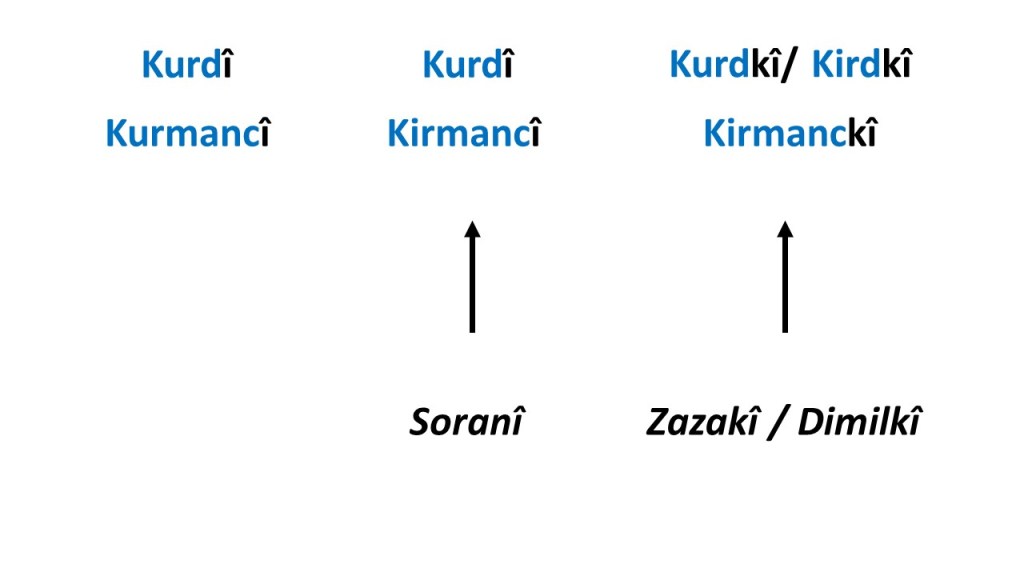
An example of the separation of modern Kurdish dialects can be seen with the Zazakî dialect of Kurdish. This dialect shares a lot of vocabulary with other Kurdish dialects. It also has grammatical features such as ergativity and grammatical gender that are seen in other Kurdish dialects. Other names for this dialect, used by native Kurdish Zazakî speakers, include Kirmanckî and Kirdkî. These words are cognates with the words Kurmancî/ Kirmancî and Kurdî respectively, seen in other Kurdish dialects such as Kurmancî and Soranî. However, the Zazakî dialect has been falsely considered as “non-Kurdish” and an “Iranian language” belonging to the “Zaza-Gorani languages”.
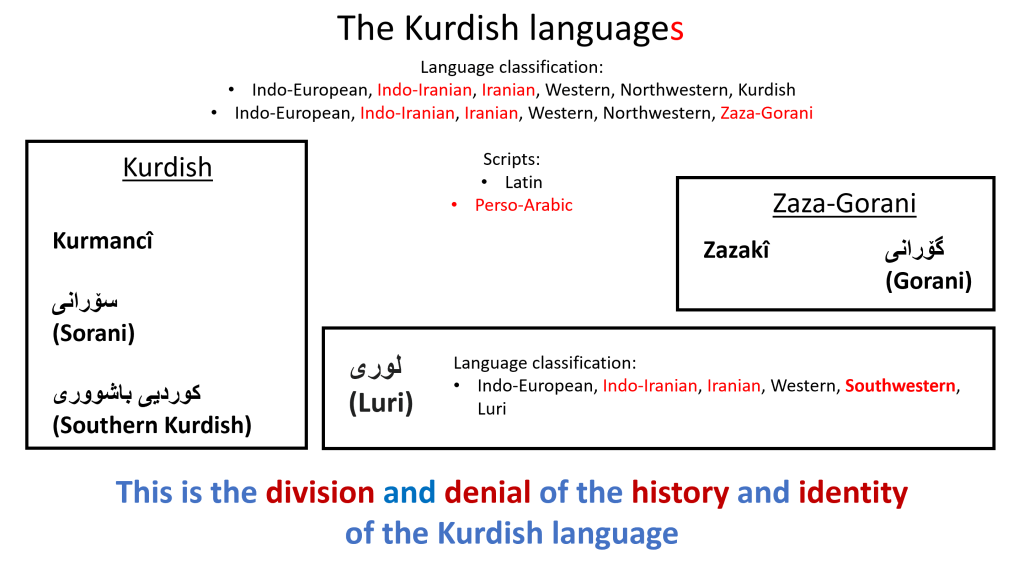
The name Kurdistan truly has a Kurdish etymology, which should be explored. Whilst the name Kurdistan is truly of (non-Indo-Iranian) Indo-European etymology, rediscovering the other historical names that refer to the Kurdish settlement area will be further proof against the imposition of a false Indo-Iranian/ Iranian/ Iranic identity.
It is important to note that historic variants of the Kurdish language and languages that led to the formation of the modern Kurdish language, recognised as Indo-European, have been falsely labelled as either “Anatolian” or “Indo-Iranian”. Meanwhile, other historic variants of the Kurdish language, some examples being Hurrian, Urartian, and Kassite, that have been denied its recognition as Indo-European, have been labelled as languages belonging to extinct language families or as language isolates.
*Did you Know?
The name Gondwana, roughly meaning ‘village land’, or “land of villages” was used in the ancient Luwian language to refer to the Kurdish settlement area. The word gund is still used in the modern Kurdish language, meaning ‘village’.
The word Kurmancî
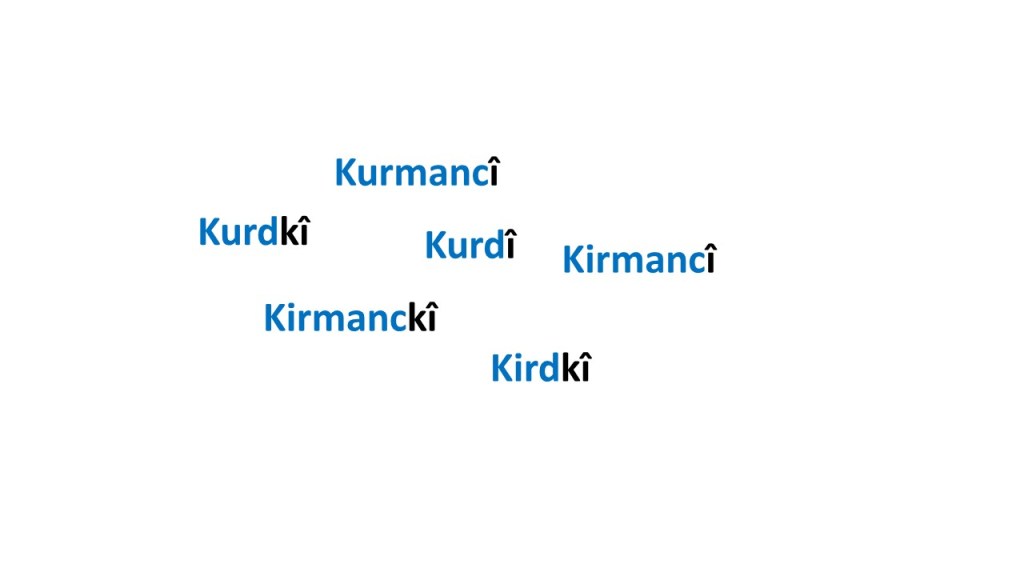
The word Kurmancî has multiple meanings. It can represent a particular dialect of Kurdish that is known as ‘Kurmancî’. Meanwhile, the word is sometimes used to represent two particular dialects of Kurdish, currently known as Kurmancî and Soranî. However, this word truly represents the whole Kurdish language, including every dialect. The Soranî dialect of Kurdish is also referred to as Kirmancî. The Zazakî dialect of Kurdish is also referred to as Kirmanckî.
Why is this important?
It makes sense to explore the etymology of the word Kurmancî along with the names of each dialect of Kurdish. This could possibly show why the word Kurmancî carries multiple meanings. It could also allow us to understand the relationship between each dialect of Kurdish and how they developed through time.
 Kurdish Writing