Newroz Pîroz Bêt! Newroz Pîroz Be! Newroz Pîroz Bo!
Happy Newroz!
Kurdish Latin Alphabet
| A a | B b | C c | Ç ç | D d | E e | Ê ê |
| F f | G g | H h | I i | Î î | J j | K k |
| L l | Ł ł | M m | N n | Ň ň | O o | P p |
| R r | Ř ř | S s | Ş ş | T t | U u | Û û |
| Ü ü | V v | W w | X x | Y y | Z z |
The Kurdish Latin Alphabet uses the Latin script. It has been derived from the Kurdish Hawar Alphabet.
This alphabet is for every dialect of the Kurdish language:
1. Kurmancî
2. Kirmanckî/ Zazakî
3. Kirmancî/ Soranî
4. Hewramî
5. Kełhuřî
6. Luřî
Example and Conversion Table
| Kurdish Latin Alphabet | Example | Cyrillic | Abjad |
| A a | a in after | А а | ا |
| B b | b in brother | Б б | ب |
| C c | j in jog | Щ щ | ج |
| Ç ç | ch in chat | Ч ч | چ |
| D d | d in door | Д д | د |
| E e | a in about / e in red | Ә ә | ە |
| Ê ê | ea in bear | Э э | ێ |
| F f | f in fast | Ф ф | ف |
| G g | g in goat | Г г | گ |
| H h | h in hill | Һ һ | ھ |
| I i | i in tip / io in station | Ь ь | ئ |
| Î î | ee in tree | И и | ی |
| J j | s in measure | Ж ж | ژ |
| K k | k in kite | К к | ک |
| L l | l in lesson | Л л | ل |
| Ł ł | ll in the Albanian word lloj | Л’ л’ | ڵ |
| M m | m in milk | М м | م |
| N n | n in note | Н н | ن |
| Ň ň | ng in ring | нг | نگ |
| O o | o in shore | O o | ۆ |
| P p | p in pan | П п | پ |
| R r | r in the Spanish word pero | Р р | ر |
| Ř ř | rr in the Spanish word zorro | Р’ р’ | ڕ |
| S s | s in sip | С с | س |
| Ş ş | sh in shell | Ш ш | ش |
| T t | t in tap | Т т | ت |
| U u | u in the Russian word sukhoj (сухой) | Ӧ ӧ | و |
| Û û | u in the Spanish word tortuga | У у | وو |
| Ü ü | ü in the German word über | ——– | ۊ |
| V v | v in vest | В в | ڤ |
| W w | w in water | Ԝ ԝ | و |
| X x | ch in the German word buch | Х х | خ |
| Y y | y in year | Й й | ی |
| Z z | z in zebra | З з | ز |
The letter Q is not Kurdish
The letter Q has been removed.
The sound made by the letter Q is not from the Kurdish language. It did not exist in the ancient Kurdish language. It does not belong in the modern Kurdish language.
The letter Q and the sound it represents do not belong in the Kurdish language.
The letter Ü is seen in the Kełhuřî dialect of the Kurdish language.
Kurdish translation of the word “Blood“
| Kurdish – Kełhuřî | Xün |
| Kurdish – Luřî | Xwîn |
| Kurdish – Kurmancî | Xwîn |
| Kurdish – Soranî | Xwên |
| Kurdish – Hewramî | Winî |
| Kurdish – Zazakî | Gonî |
Kurda
The old name of Kurdistan
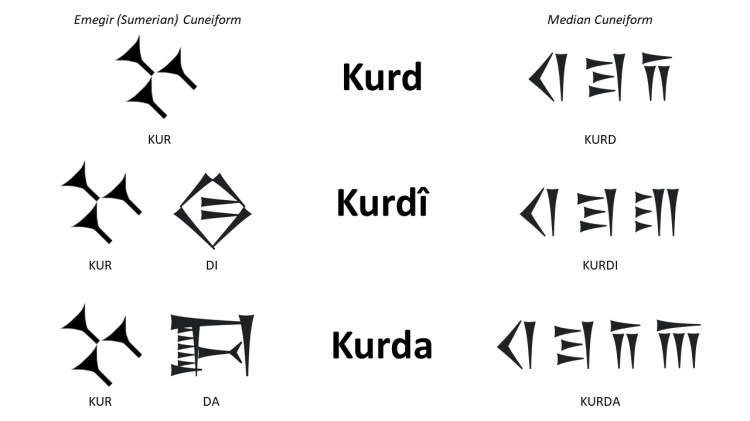
The old name for the Kurdish settlement area is Kurda.
The name Kurda has a Hurrian and Sumerian etymology.
This name has been used since at least the 3rd Millennium BCE.
Kurda has been mentioned in cuneiform tablets produced in 23rd Century BCE, 18th Century BCE, and 13th Century BCE.
Kurda was a city-state in Upper Mesopotamia around 1770 BCE.
In Sumerian, the Kurdish settlement area was called “Land of Karda”.
Sumerian: ‘Kur’ represents ‘Mountain’. ‘Kurti’ represents ‘Mountain people’, referring to Kurds.
The suffix (word-ending) -stan was imposed on the name around the 12th Century AD.
Notice
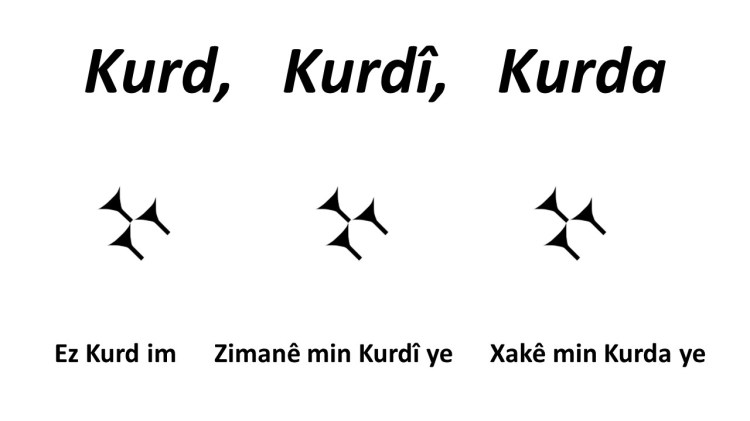
The inscription ‘𐎤𐎼𐎭’ on the Duhok SC (Duhok Sports Club) 2024-2025 Kit has been derived from the ‘Kurd, Kurdî, Kurda – Cuneiform’ image, from kurdishwriting.com.
However, it was publicly unsourced and no credit was shown to Kurdish Writing, kurdishwriting.com.
We kindly ask anyone publicly using our content to show its source.
Thank you.
Nivîsa ‘𐎤𐎼𐎭’ li ser bergê Duhok SC (Duhok Sports Club) 2024-2025 ji wêneya ‘Kurd, Kurdî, Kurda’ ji ‘kurdishwriting.com’ hatiye wergirtin.
Bêçavkanî bû û çavkaniya wê nehat nîşandan.
Em daxwaz dikin ku her kesê ku naveroka me bikar tîne çavkaniya xwe nîşan bide.
Gelek sipas.
The native people of the ancient Mesopotamia-Zagros region developed the Cuneiform and Linear Elamite writing scripts:

Cuneiform was used as early as the 4th millennium BCE within the Sumerian civilization of Mesopotamia. It began as Archaic Cuneiform until becoming Early Dynastic Cuneiform in the mid-3rd millennium BCE.

The Medes Empire was established in the 1st millennium BCE. Numerous sources establish the Medes being one of the Indo-European-speaking predecessors of the modern Kurdish identity. The cuneiform writing system was further developed into a new cuneiform script that was utilised for re-branding Median culture, history and traditions as Achaemenid.
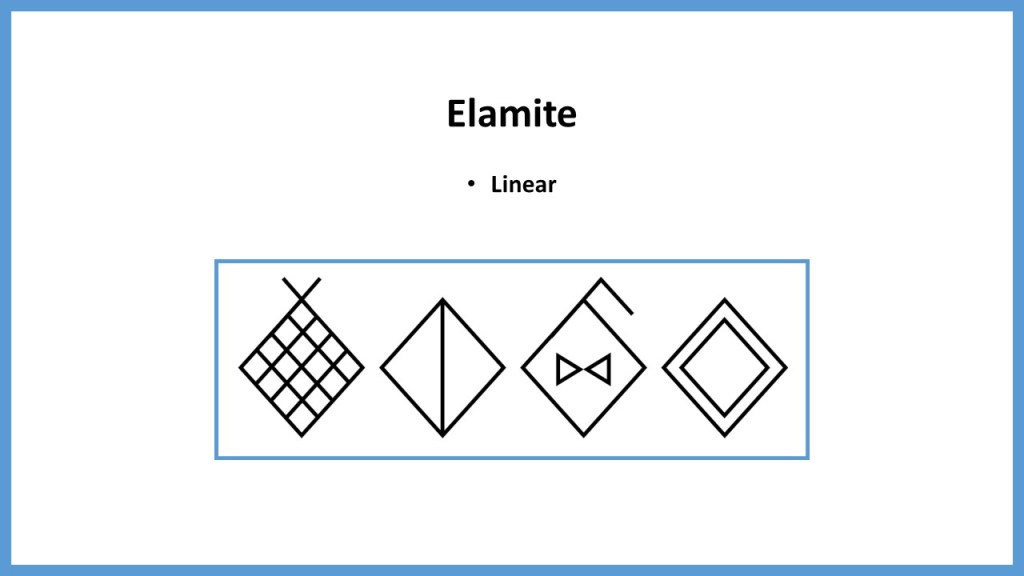
Elamite (Linear Elamite/ Linear Gutian) was used as early as the 3rd millennium BCE within the Elam region of the Zagros mountains.
Update:
Video ~ Kurdish Kełhuřî Numbers – Kurdî Kełhuřî
Video ~ Kurdish Hewramî Numbers – Kurdî Hewramî
Video ~ Kurdish Zazakî Numbers – Kurdkî Kirmanckî
Kurdish Writing
 Kurdish Writing